

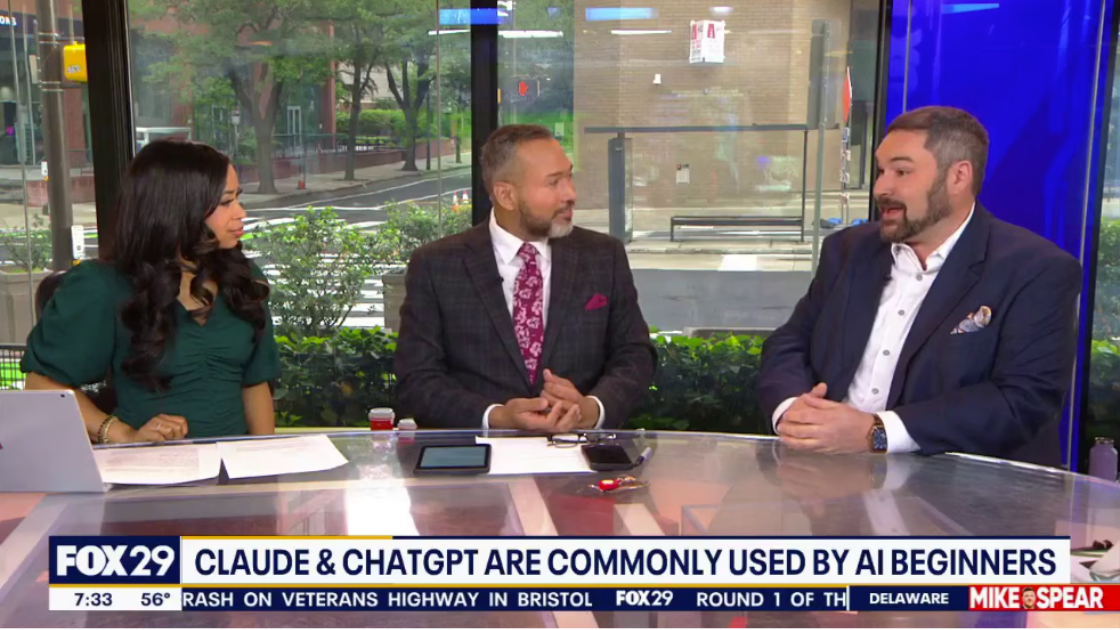
The AI jobs companies can’t fill are no longer a future concern. They are already shaping how businesses operate today. During a recent Fox 29 Philadelphia interview, Liberty Fox Technologies’ CEO spoke about how AI is already transforming the hiring process itself, from resume screening to early-stage candidate evaluation. These shifts point to a larger issue. Businesses are struggling to build the capabilities needed to use AI effectively.
As a result, many organizations are rethinking how they approach AI. It is no longer just a tool, it has become a capability that must be designed, structured, and managed over time.
Watch the Video Here:

Why Companies Struggle to Fill AI Jobs
The AI job market is expanding rapidly, but not evenly. Traditional roles in business operations and software development are stabilizing or shrinking. In contrast, AI-focused roles continue to grow, especially those tied to building, managing, and evaluating intelligent systems.
At the same time, AI is already influencing how hiring works. As discussed in the Fox 29 interview, companies are increasingly using automation to filter and prioritize candidates before a human ever reviews a resume. Companies are hiring for new roles through systems that require increasingly specific criteria.
This imbalance creates a gap that companies struggle to close. Even with significant hiring efforts, many organizations cannot find candidates with the right mix of technical knowledge, systems thinking, and operational judgment.
The Real Skills Behind the Gap
These roles are difficult to fill because they require a combination of capabilities that rarely exist in one role.
Some of the most in-demand skills include:
- Translating business needs into clear instructions for AI systems
- Evaluating outputs and identifying subtle errors
- Designing workflows across tools or systems
- Diagnosing failure patterns unique to AI behavior
- Structuring internal data so systems retrieve the right information
- Managing cost efficiency in usage-based AI environments
These skills function together as a system. Many hiring approaches fall short because they focus on filling individual roles instead of building coordinated capability.
At the same time, candidates are navigating increasingly AI-driven hiring processes. As highlighted in the Fox 29 interview, even strong candidates can be filtered out if their experience does not translate well into structured formats that AI systems recognize. This reinforces the idea that the gap is not just about talent availability. It is about alignment between people, systems, and expectations.
Why Hiring Alone Is Not Enough
Hiring is often the default solution to capability gaps. In the case of AI, this approach can create more challenges than results.
Even highly skilled individuals depend on several factors:
- Defined workflows
- Structured and reliable data
- Clear use cases
- Alignment across teams
Without these, even strong hires may struggle to produce meaningful outcomes.
This means AI implementation is not just a hiring issue. It is also a structural and operational challenge. On one side, they cannot easily find the right talent. On the other hand, the hiring processes themselves are evolving with AI, introducing new barriers for both employers and candidates.
A Shift in Strategy: From Hiring to Capability Building
As companies encounter these challenges, a shift in strategy is becoming more common. Instead of relying entirely on hiring, organizations are exploring how to build AI capabilities more intentionally.
This includes:
- Assessing workflows to identify opportunities for AI integration
- Creating evaluation processes to ensure outputs are reliable
- Organizing internal data to improve system performance
- Starting with small, focused use cases
Rather than attempting full-scale transformation at once, many organizations are taking a phased approach. They treat AI as a capability that develops over time based on real business needs.
What This Means for Your Business
If your organization is exploring AI or trying to expand its use, the key takeaway is simple.
You do not need to close the entire talent gap immediately.
Instead, focus on building the conditions that allow AI to work effectively:
- Clear definition of tasks and objectives
- Strong evaluation of outputs
- Structured and accessible information
These foundations make it easier to scale AI initiatives with confidence and reduce unnecessary risk.
Where to Start
A practical starting point does not require a major overhaul. It begins with asking the right questions:
- Which processes could benefit from better automation or support?
- Where does unstructured information slow down decision-making?
- How are AI outputs currently being evaluated?
These questions can help identify the most important gaps and guide the next steps toward building capability.
The Bigger Picture
The AI jobs companies can’t fill are not simply a hiring problem. They reflect a broader shift in how work is being structured and performed.
Organizations that recognize this shift early gain an advantage. It comes from building systems, workflows, and strategies that allow people and technology to work together more effectively.
In a landscape where talent is limited, adaptability becomes the defining factor for long-term success.
If you are currently struggling to fill AI roles, structure your workflows, or make sense of how AI fits into your business, these are challenges we help solve every day. Liberty Fox Technologies partners with companies to bridge these gaps through practical, real-world solutions. If you are ready to take the next step, you can contact us to learn more.